
Posted by Bethan on Sep 30, 2026
Pheasants are a diverse group of gamebirds, ranging from the familiar Common Pheasant seen across the British countryside to colourful species such as the Golden Pheasant and Lady Amherst's Pheasant.
There are many different types of pheasants found around the world, particularly across Asia. They vary considerably in size, colouring, markings and habitat.
You may also see them described as different pheasant breeds. When talking about wild pheasants, species and subspecies are generally more accurate terms. A breed normally refers to animals that have been selectively bred by people.
In this guide, we'll look at some of the different pheasant species, where they originate and the features that can help you identify them.
How Many Types of Pheasants Are There?
There isn't one universally agreed number of pheasant species.
The figure varies because different taxonomic authorities don't always classify species and subspecies in exactly the same way. Scientific classifications also change as new genetic evidence becomes available.
Pheasants belong to the Phasianidae family, alongside birds including partridges, quails and other gamebirds. Only part of this much larger family consists of birds commonly described as pheasants.
This is why you may find different answers when searching for the number of pheasant species in the world.
Different Types of Pheasants Around the World
Pheasants are particularly associated with Asia, although some species have been introduced to other parts of the world.
Here are some of the different pheasant species you may come across, including their native ranges and some of the features that can help you identify them.
Common Pheasant
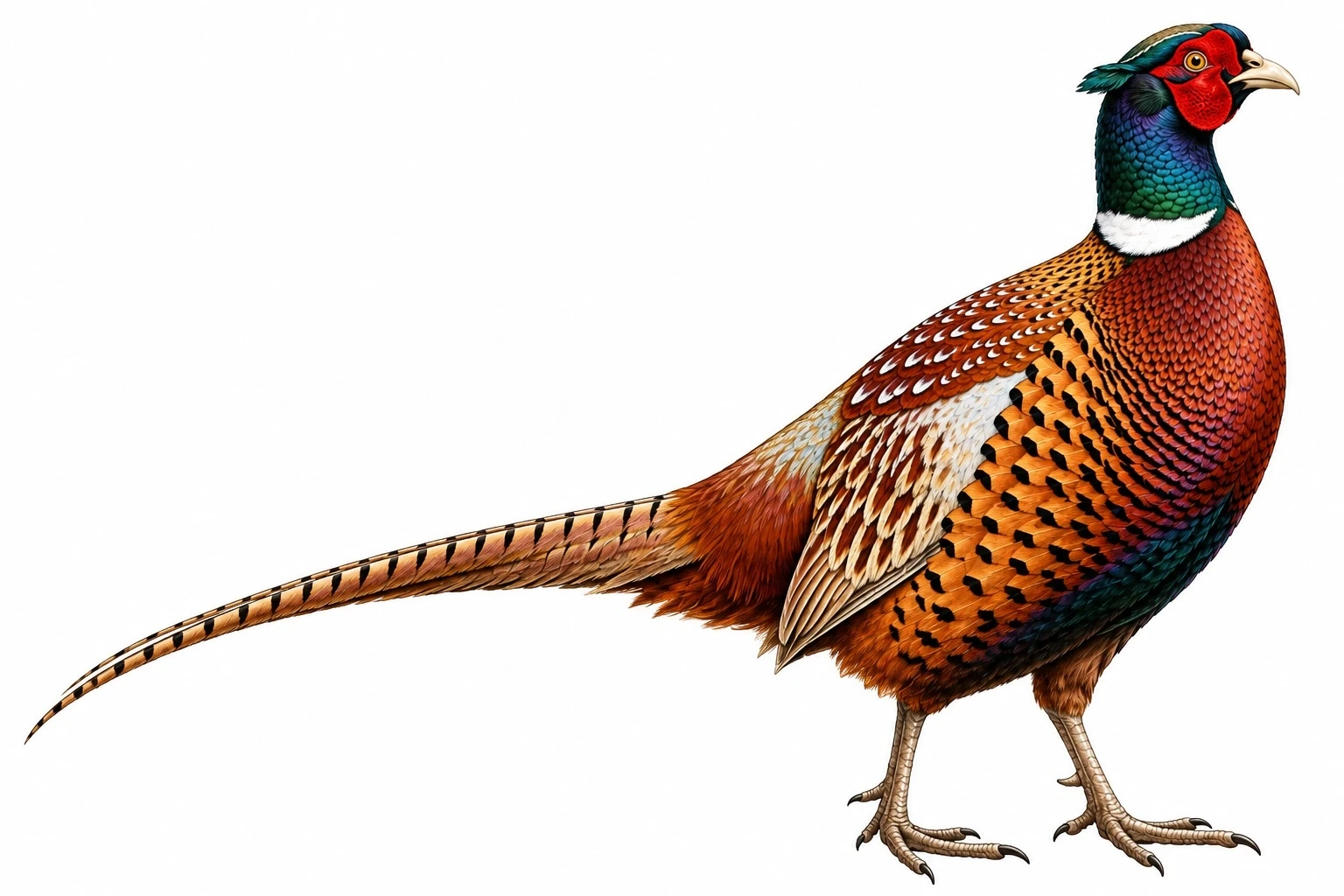
Scientific name: Phasianus colchicus
Native range: Asia, extending from the Caucasus through Central Asia and into China and Korea
The Common Pheasant is the species most familiar to people in Britain.
Males can vary considerably in appearance but typically have rich copper and golden-brown plumage, an iridescent green head and a long barred tail. Some have a distinctive white neck ring. Females are much less colourful, with mottled brown plumage that provides camouflage.
Although now widespread in Britain, the Common Pheasant isn't native to the British Isles. It is an introduced species that has become established across much of the country.
Golden Pheasant
Scientific name: Chrysolophus pictus
Native range: Central and western China
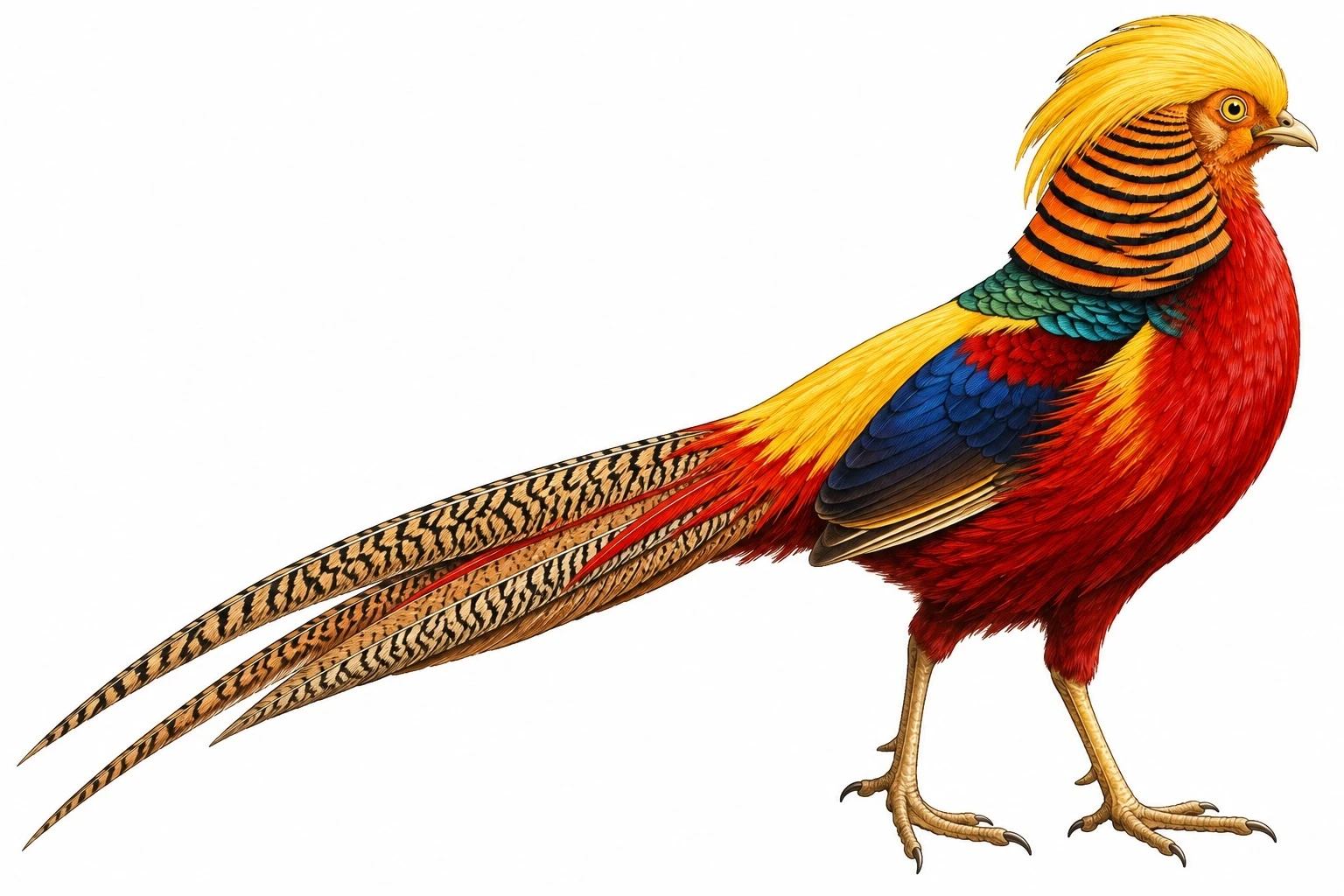
The male Golden Pheasant is one of the easiest pheasant species to recognise.
It has a bright golden-yellow crest, red body, blue rump and a long patterned tail. Females are much less conspicuous and predominantly mottled brown.
Golden Pheasants have also been introduced outside their native range, including Britain. However, Britain's formerly established populations have declined dramatically, so older reports suggesting there are large wild British populations are now outdated.
Lady Amherst's Pheasant
Scientific name: Chrysolophus amherstiae
Native range: Southwestern China and northern Myanmar
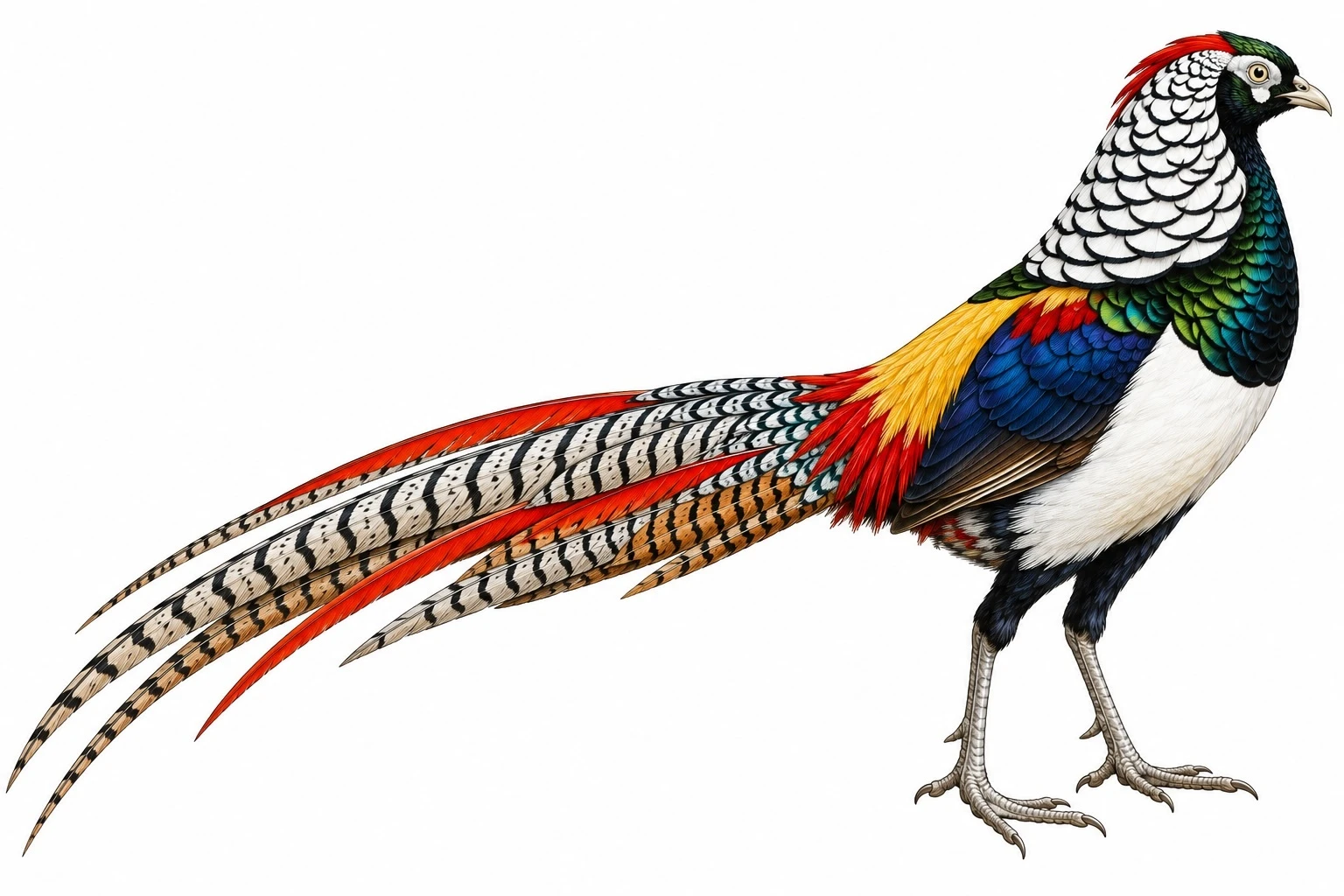
Male Lady Amherst's Pheasants are striking birds with a white and black barred cape, red body and exceptionally long patterned tail.
Females have mottled brown plumage and can be considerably harder to identify.
Lady Amherst's Pheasants were once established in parts of Britain, particularly Bedfordshire, but that population disappeared. Recent British sightings are generally considered escaped or released birds rather than evidence of an established wild population.
Reeves's Pheasant
Scientific name: Syrmaticus reevesii
Native range: Central and eastern China
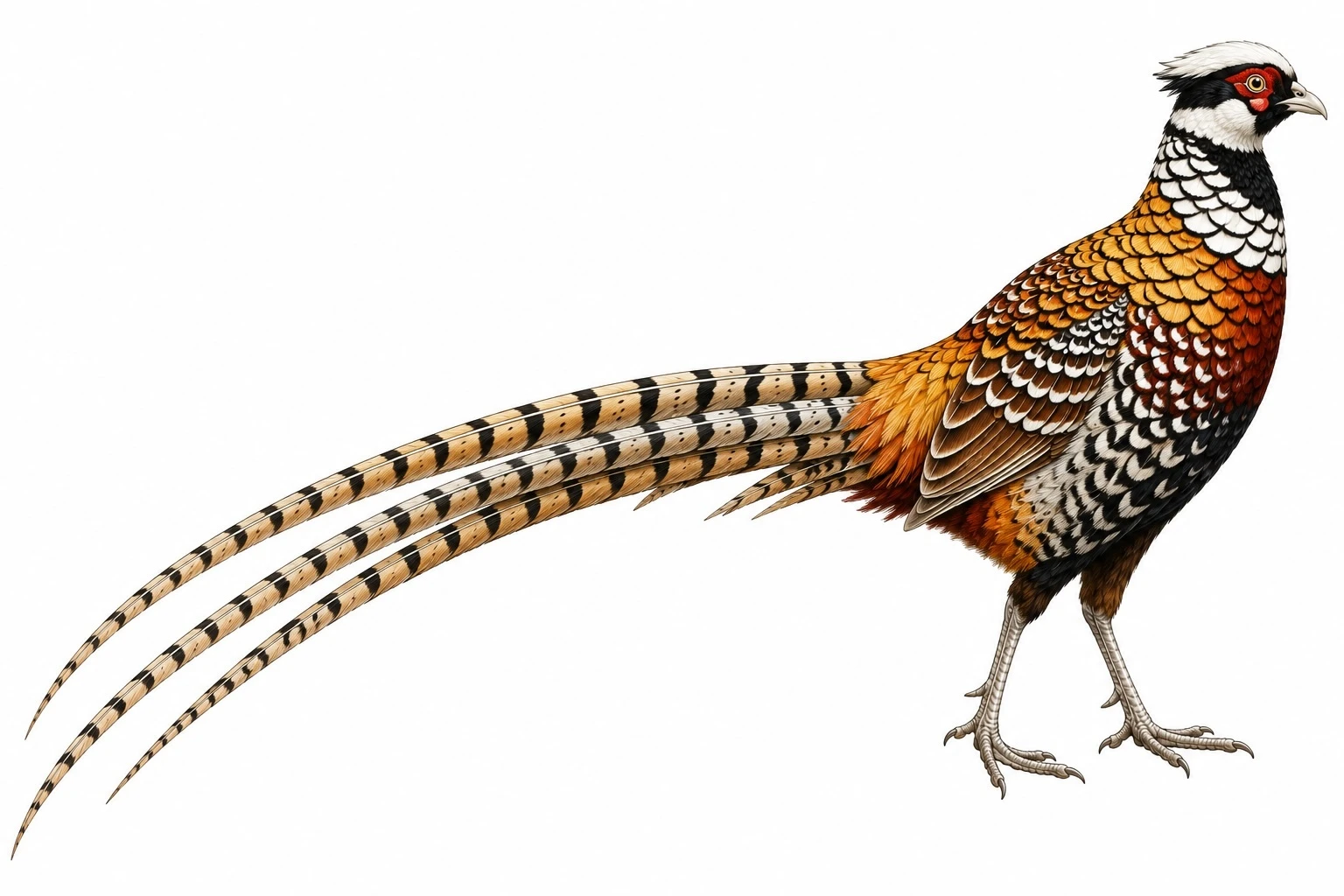
Reeves's Pheasant is particularly notable for the male's extremely long tail.
Males have a golden-white body covered with dark scale-like markings and a long patterned tail. Females are predominantly mottled brown.
The species has been introduced outside China, including into parts of Europe. Unlike the widespread Common Pheasant, it isn't considered an established, self-sustaining British species.
Silver Pheasant
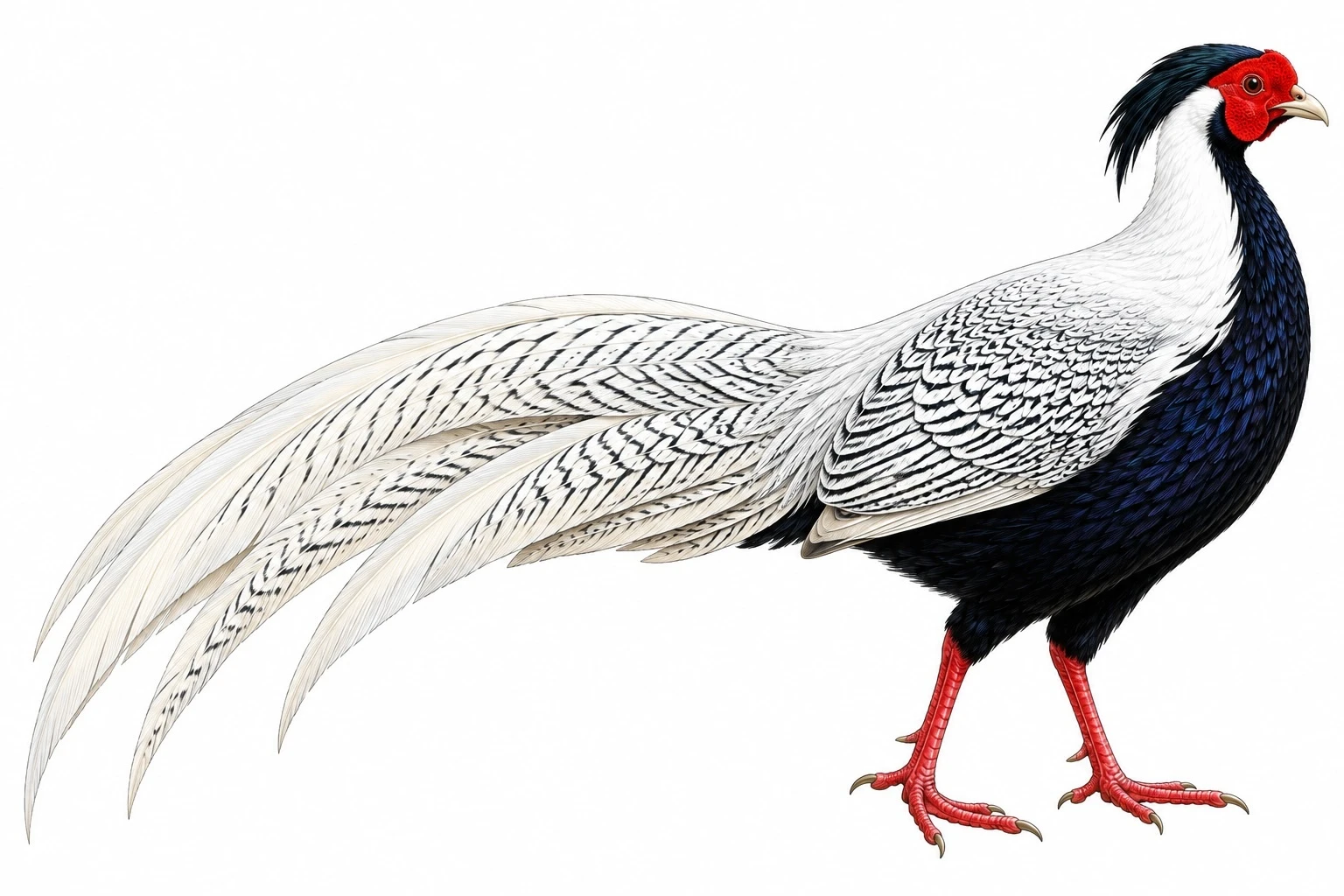
Scientific name: Lophura nycthemera
Native range: Southern China and parts of mainland Southeast Asia
The male Silver Pheasant has white upperparts marked with fine black patterning, contrasting black underparts and bright red facial skin. Its long white tail adds to its distinctive appearance.
Females look very different, with predominantly brown plumage.
There are a number of subspecies, which means appearance can vary between populations.
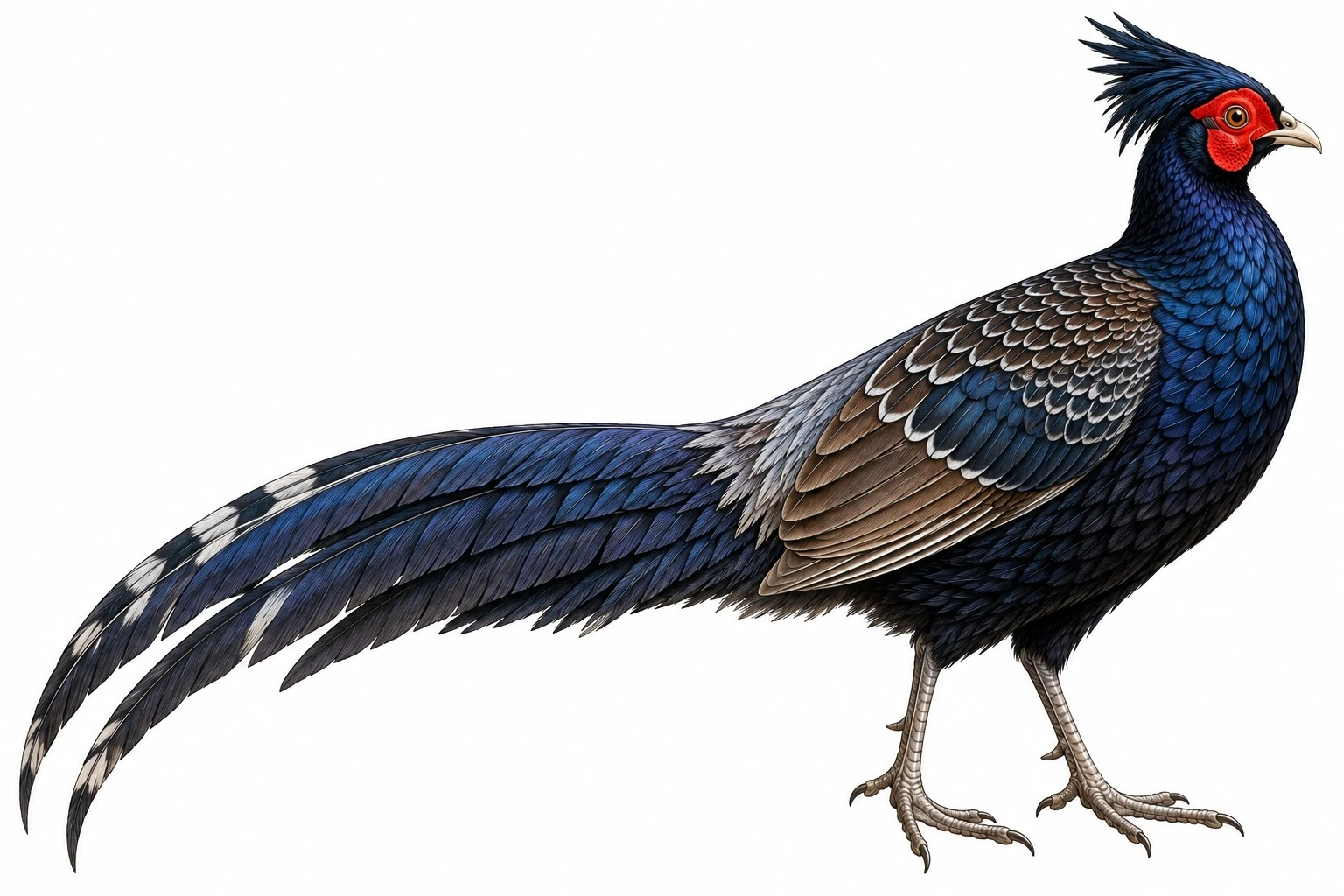
Kalij Pheasant
Scientific name: Lophura leucomelanos
Native range: Himalayan region and parts of South and Southeast Asia
The Kalij Pheasant varies considerably in appearance across its geographic range.
Males are generally dark grey or black with conspicuous red facial skin, while females tend to have brown plumage.
Different subspecies can show noticeable differences in colouring and markings, which can make identification less straightforward than with some pheasant species.
Swinhoe's Pheasant
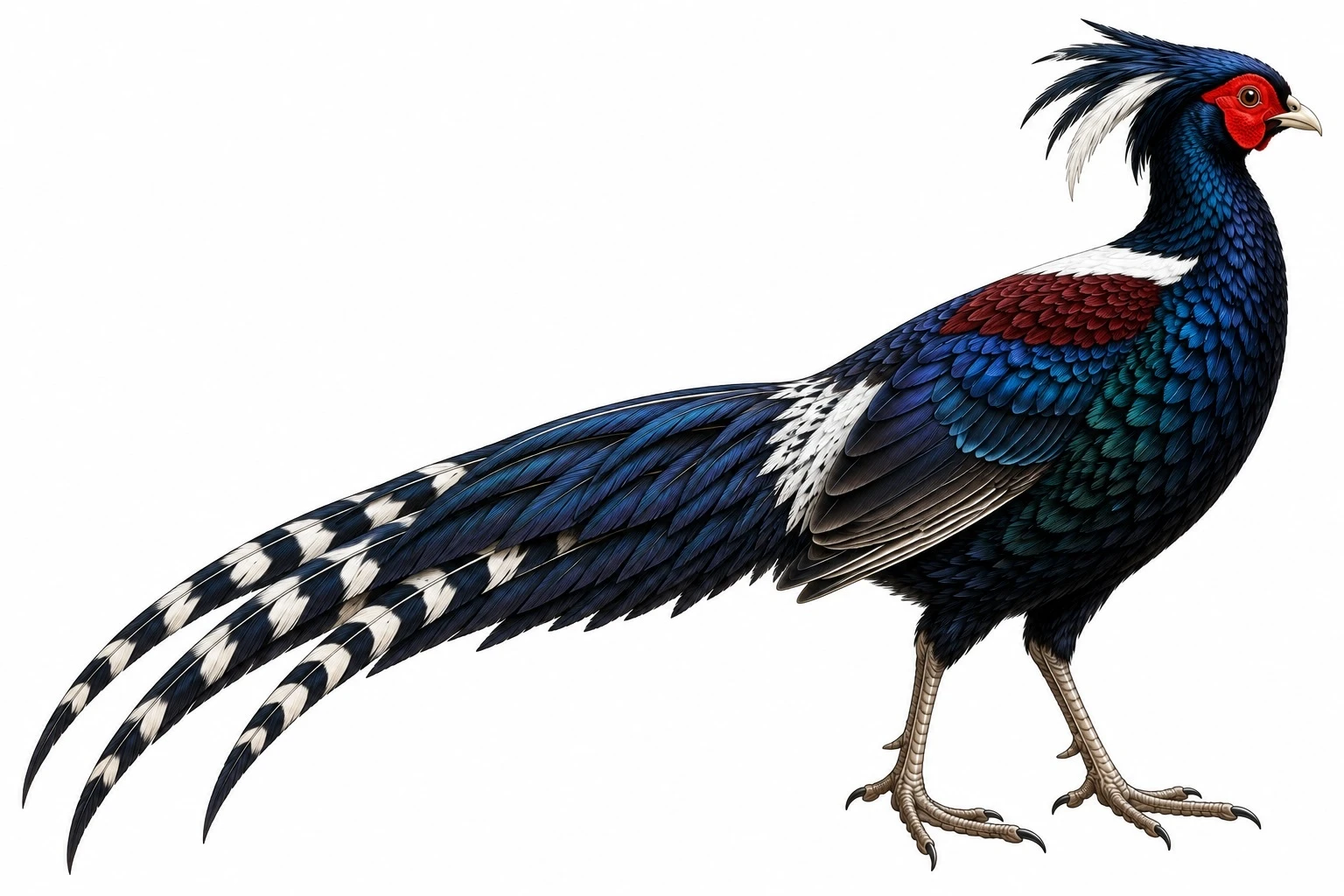
Scientific name: Lophura swinhoii
Native range: Taiwan
Swinhoe's Pheasant is endemic to Taiwan, meaning this is its natural home and it isn't naturally found elsewhere.
The male has dark blue-black plumage, contrasting white markings on the neck and tail and bright red facial skin. Females have much more subdued brown colouring.
Its restricted natural range also makes conservation of the species particularly important.
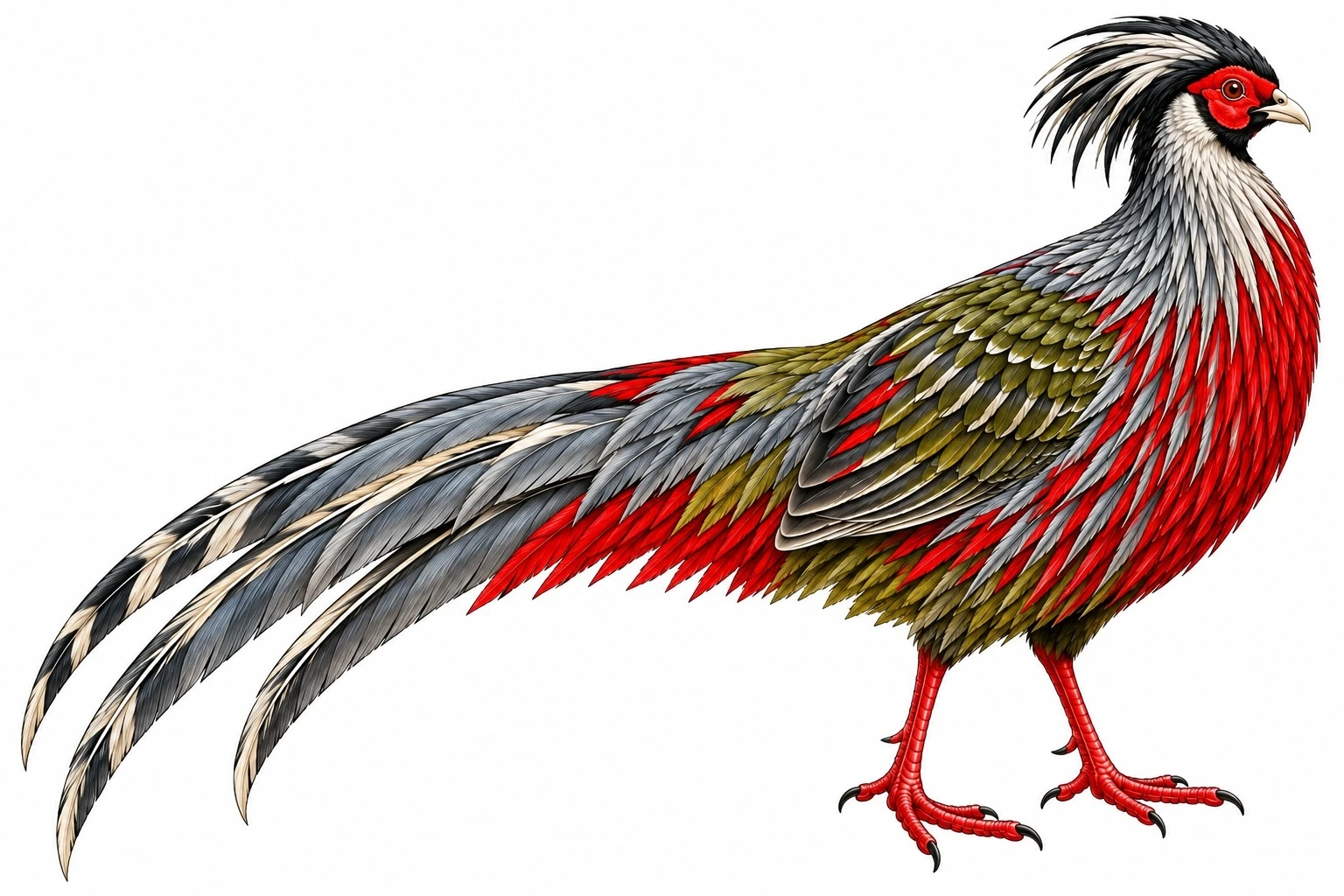
Blood Pheasant
Scientific name: Ithaginis cruentus
Native range: Himalayan region, including parts of China, Bhutan, India, Nepal and Myanmar
The Blood Pheasant gets its memorable name from the crimson-red colouring found around the male's underparts, tail and legs.
It is quite different in appearance from the long-tailed pheasants many people picture when they hear the word "pheasant". It has a comparatively compact body, grey plumage and a short, spiky crest.
Koklass Pheasant
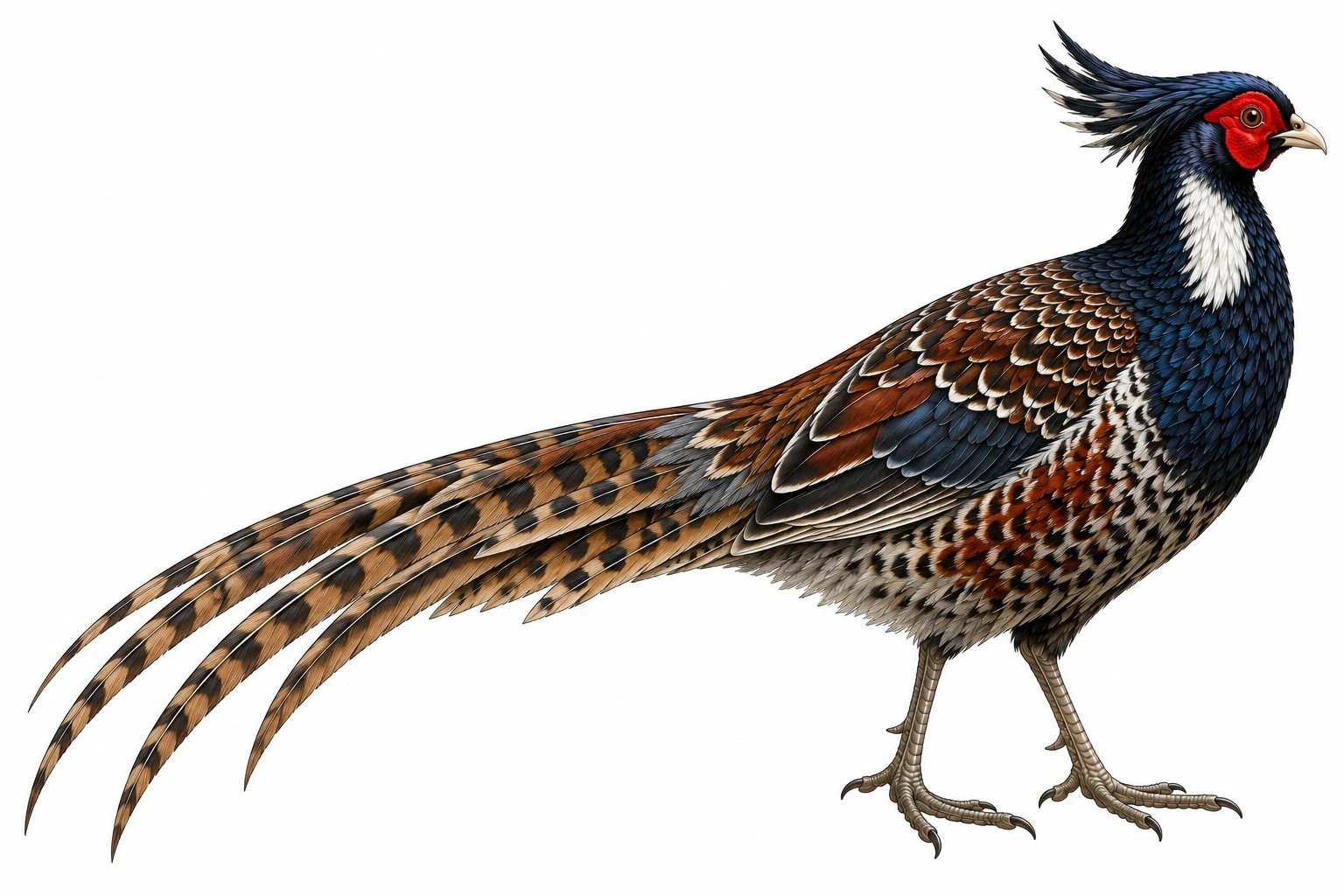
Scientific name: Pucrasia macrolopha
Native range: Himalayan and mountainous regions of Asia
The Koklass Pheasant is another species that looks quite different from the Common Pheasant.
Males have dark plumage with pale markings, a chestnut-coloured area around the head and neck and a graduated tail. Females are more subdued in colour.
The species occurs across mountainous areas extending from Afghanistan and Pakistan through the Himalayas towards China and Myanmar.
Pheasant Species Around the World
Many pheasant species originate in Asia, with native ranges stretching from the Himalayas and Southeast Asia to China, Taiwan and Japan. This illustrated map gives a quick guide to the general native ranges of nine pheasant species across Asia.
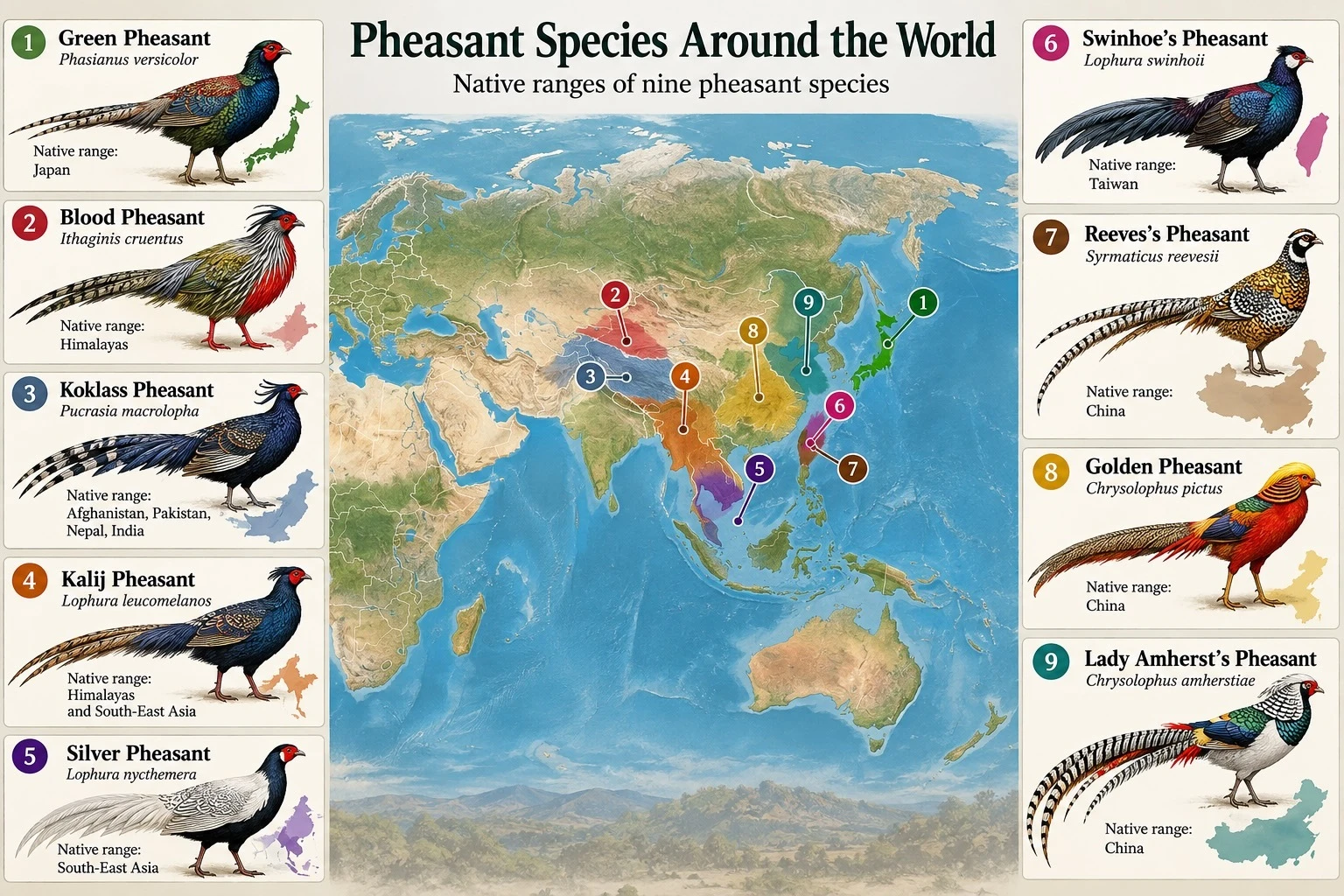
Species shown: Green Pheasant, Blood Pheasant, Koklass Pheasant, Kalij Pheasant, Silver Pheasant, Swinhoe's Pheasant, Reeves's Pheasant, Golden Pheasant and Lady Amherst's Pheasant.
How Can You Identify Different Pheasant Species?
Male pheasants are generally easier to distinguish because many species have distinctive colours, crests, facial markings or tails.
Some useful features to look at include:
- Head and crest: Golden Pheasants have their unmistakable golden crest, while other species have darker or less prominent crests.
- Neck markings: The white neck ring often associated with Common Pheasants can be useful, although not every Common Pheasant has one.
- Facial skin: Several species have conspicuous red facial skin.
- Body colouring: This ranges from the copper tones of Common Pheasants to the black and white colouring of Silver Pheasants.
- Tail: Tail colour, markings and length can be particularly useful. Reeves's Pheasant is a good example because of its exceptionally long tail.
- Location: Knowing where the bird was seen can substantially narrow the possibilities.
Females can be harder to identify because several species have predominantly brown, mottled plumage.
Golden Pheasant vs Lady Amherst's Pheasant
These are two of the most colourful pheasants and can sometimes be confused.
A male Golden Pheasant has a solid golden-yellow crest and predominantly red body.
A male Lady Amherst's Pheasant has a distinctive white and black barred cape and a very long patterned tail.
Females of both species are brown and much less distinctive, so identification requires closer attention to their markings.
What Types of Pheasants Are Found in the UK?
The pheasant you're overwhelmingly most likely to encounter in Britain is the Common Pheasant.
Despite being such a familiar sight in the British countryside, it isn't native to Britain. It was introduced and subsequently became widespread.
Other pheasant species have also been introduced at various times.
Golden Pheasants once had established British populations, but their numbers have declined heavily.
Lady Amherst's Pheasant was also formerly naturalised in Britain, but its established population has disappeared.
Occasional sightings of other species don't necessarily mean that a self-sustaining wild population exists. Escaped or released birds can also turn up in the countryside.
Is a Ring-Necked Pheasant a Different Species?
Not usually.
The name Ring-necked Pheasant is commonly associated with forms of the Common Pheasant that have a prominent white neck ring.
Modern classifications don't treat the Ring-necked Pheasant as a completely separate species from the Common Pheasant. The name has historically been associated particularly with Phasianus colchicus torquatus, one of the Common Pheasant forms originating in China.
This is another example of why pheasant names and classifications can become confusing.
Are Pheasant Breeds and Species the Same Thing?
No.
Although "pheasant breeds" is commonly used in everyday searches, species is normally the better term for distinct wild pheasants such as the Golden Pheasant, Common Pheasant and Reeves's Pheasant.
A subspecies is a recognisable geographic population within a species.
A breed generally refers to a domesticated animal population shaped through selective breeding by people.
So if you're comparing the different pheasants found naturally around the world, you're usually comparing pheasant species and subspecies rather than breeds.
Clothing for Pheasant Shooting
If you're heading out for a pheasant shoot, the right clothing will depend on the weather, terrain and type of shoot. You can browse our shooting clothing for waterproof field wear, traditional shooting clothing, layers, trousers and accessories for days in the field.
Shooting Clothing
Browse clothing, footwear and accessories for game shooting, beating and other field sports.
Shop Shooting Clothing →Men's Shooting Clothing
Shop shooting jackets, trousers, breeks, shirts, fleeces, smocks and field clothing for men.
Shop Men's Shooting Clothing →Ladies' Shooting Clothing
Browse women's shooting jackets, trousers, waistcoats, shirts and practical field clothing.
Shop Ladies' Shooting Clothing →Related Pheasant & Game Shooting Guides
If you're interested in pheasants from a field sports perspective, these guides cover pheasant beating, game shooting and preparing for a day in the field.



Find our country clothing guides useful?
Add Cherry Tree Country Clothing as a preferred source on Google to see more of our guides in Google Search.